By Propzine – Bengaluru’s Trusted PropTech Platform
Real estate valuation is the foundation of every property transaction whether you're buying, selling, renting, investing, or refinancing. As India's real estate market grows more data-driven, understanding real estate valuation methods has become essential for homebuyers, investors, and developers. In cities like Bengaluru, where micro-markets vary significantly in pricing and demand cycles, accurate valuation ensures transparency and informed decision-making.
Understanding the Comparable Sales Method: The Market-Driven Approach
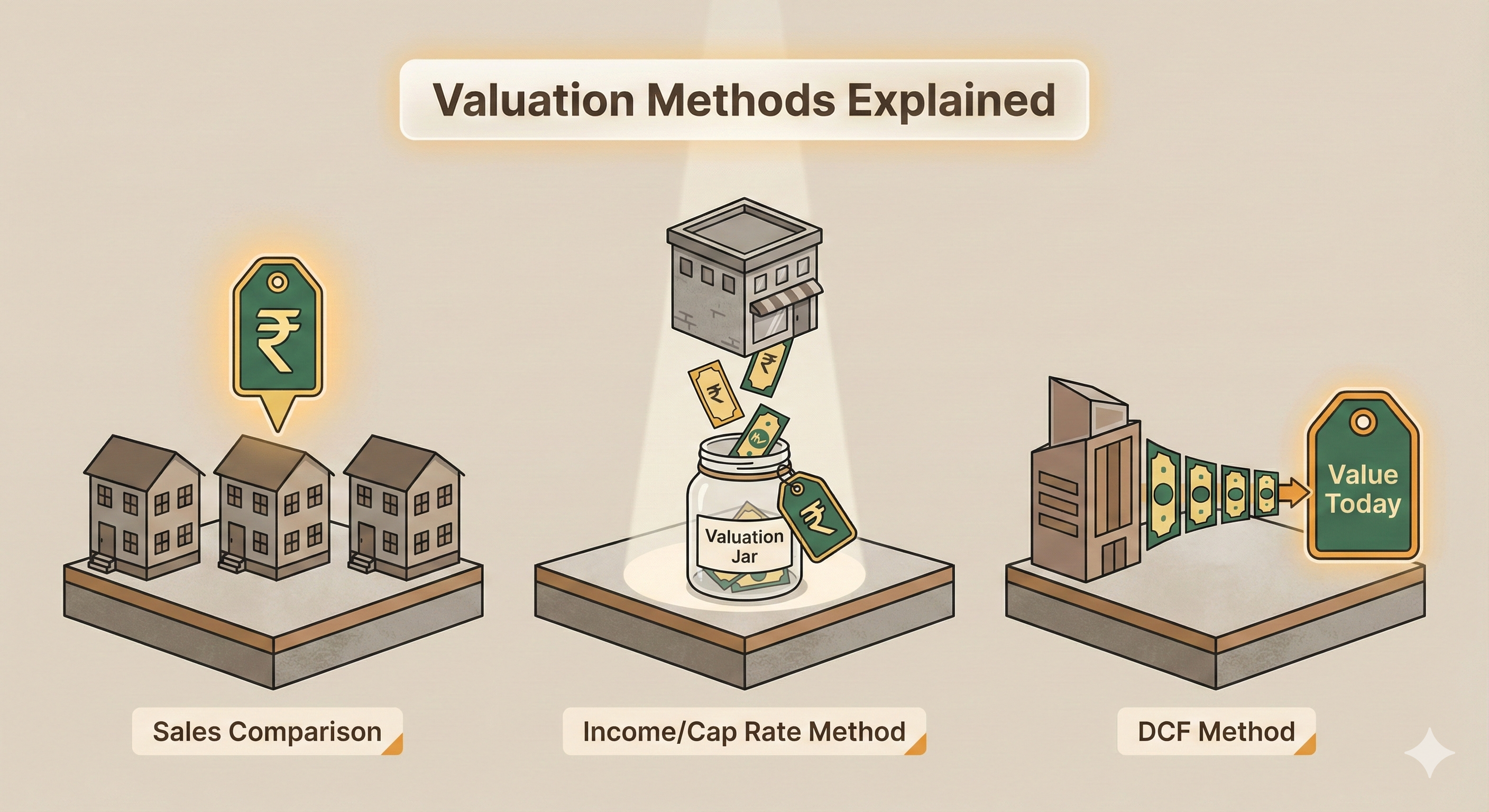
The Comparable Sales Method often called the Market Approach is the most widely used property appraisal method, especially for residential assets. It determines a property’s value by examining recent sales of similar homes within the same locality. Factors such as property size, age, amenities, facing, project reputation, and proximity to infrastructure are considered and adjusted to arrive at the most accurate estimate.
In Bengaluru’s dynamic micro-markets from Whitefield to Jakkur and Kanakapura Road—this method works extremely well because of abundant transaction data and high buyer–seller visibility. The property valuation comparable sales approach is particularly useful for end-user markets where emotional value blends with market demand. However, accuracy depends heavily on the quality of available data, which is why modern proptech platforms play a crucial role in refining comparable insights.
Income Approach: Valuing Property Through Earnings Potential
The Income Approach in property valuation is ideal for income-generating assets such as commercial offices, retail spaces, co-living projects, student housing, and rental properties. It evaluates what the property is worth based on the income it can generate either through capitalization rates (cap rates) or discounted cash flow (DCF) analysis.
In Bengaluru’s thriving office and tech corridor markets like Outer Ring Road, Whitefield, Electronic City, and North Bengaluru this method is indispensable. Investors rely on projected rental yields, occupancy levels, operating expenses, and long-term income streams to assess asset performance. As institutional capital flows into India’s commercial real estate, the Income Approach has become a benchmark for transparent pricing and global investment-grade analysis.
Cost Approach: Estimating Value Through Construction & Land Costs
The Cost Approach in real estate determines property value based on how much it would cost to reconstruct or replace the asset today, minus depreciation. It is most suitable for newly built structures, unique assets, and development land where market comparables or income streams may not exist.
For developers in Bengaluru especially in emerging zones like Devanahalli, Sarjapur Road, and Hennur the cost approach real estate method helps estimate feasibility, project budgeting, and the economic value of construction. It accounts for land value, building materials, labor rates, architectural design, and regulatory costs. Although extremely precise for new builds, it can be less reliable for older properties where depreciation and structural obsolescence vary widely.
When to Use Each Method for Accurate Valuation
Each real estate valuation method has a specific purpose, and accuracy increases when applied in the right context. The Comparable Sales Method works best for ready residential properties with sufficient market data. The Income Approach is ideal for commercial or rental-driven assets where returns determine value. The Cost Approach shines in under-construction projects, institutional developments, and properties without reliable comparables.
Real-world valuation, however, often blends these methods to counter limitations. For instance, a Grade-A commercial building in Bengaluru may require both income-based and cost-based analysis to reflect realistic investor expectations.
How Proptech Platforms Bring Precision to Property Valuation
Today’s proptech innovations integrate large datasets, machine learning models, and Bengaluru-specific market intelligence to deliver more accurate and transparent valuations. Modern platforms combine comparable sales, income approach, and cost approach data into unified dashboards, offering high-accuracy insights for homebuyers, investors, developers, and lenders.
By analyzing transaction histories, rental benchmarks, construction cost indices, demand–supply patterns, and micro-market growth signals, proptech tools generate valuations that are faster, unbiased, and more adaptable to market fluctuations. In fast-evolving urban ecosystems like Bengaluru, this synthesis is essential for clarity, confidence, and better decision-making.
Conclusion: Smarter Valuations for a Data-Driven Real Estate Future
Understanding the key property appraisal methods Comparable Sales, Income Approach, and Cost Approach empowers stakeholders to navigate India’s real estate landscape with greater accuracy and trust. As proptech reshapes the industry, blended valuation models supported by real-time Bengaluru market data are becoming the gold standard. Whether you're evaluating a family home or an income-generating commercial asset, informed valuations are the cornerstone of successful real estate decisions.

 Method for Real Estate.png)